Nifty League · Web3 Gaming
Nifty League: A Gaming Platform for 10,000+ Users, Ahead of a $5M Seed Round
Led design for the landing page, public pages, game dashboard and credit-system logic.
- Role
- Lead Designer
- Scope
- Gaming platform, dashboard, credit system and public pages
- Focus
- Web3 Gaming
- Designer
 Gideon Awolesi
My contribution · Nifty League
Gaming platform, dashboard, credit system and public pages
Nifty League later announced a $5M seed round. My work covered the public story, the player dashboard, the credit and reward logic, and the flows that connected Web3 actions to the game.
- 10,000+
- users
- $5M
- seed round announced later
What I owned
- 01Designed the public site and the pages that brought players into the game.
- 02Designed the player dashboard and related account screens.
- 03Worked through the credit-system UX and interaction logic behind rewards and utility.
Clickable prototype
Open the redesigned Nifty League platform
Connect MetaMask, rent a Degen to play Nifty Smashers, and then manage your rentals, your whitelist, and your NFTL from My Dashboard.
Overview
About the project
- Role: Lead Designer at Nifty League. I worked on the public pages, marketing surfaces, game dashboard, player systems, asset logic, credit-system UX, and interactive prototypes.
- What it is: Nifty League was a Web3 gaming platform built around competitive play, player-owned assets, rewards, NFTL utility, and the wider Niftyverse. The product had to explain wallet connection, game entry, player assets, credits, marketplace actions, and dashboard management to crypto-native players, and also to people who were new to Web3.
Nifty League called itself a peer-to-peer, play-to-earn platform. Some of its games, like Nifty Smashers, need a Degen, which is one of the 9,840 pixel-art NFT characters in the collection. Other games, like WEN Game and Crypto Winter, only need arcade tokens. Players who couldn't afford a Degen could rent one from an owner and share what they won with them, and owners could sponsor other players on their own Degens.
Outcome: Nifty League later announced a $5M seed round led by RSE Ventures to expand its NFT gaming metaverse. This case study covers my work on the public pages, game dashboard, player economy, and product flows.
Prototype
- Animated flow: The video follows the clickable prototype through marketplace discovery, asset detail, rental confirmation, dashboard management, the game hub, leaderboards, wallet onboarding, failure recovery, settings, and mobile screens.
- Interactive prototype: Open the prototype. It starts with discovery and the asset decision, then moves through rental, management, retention, recovery, and mobile use.
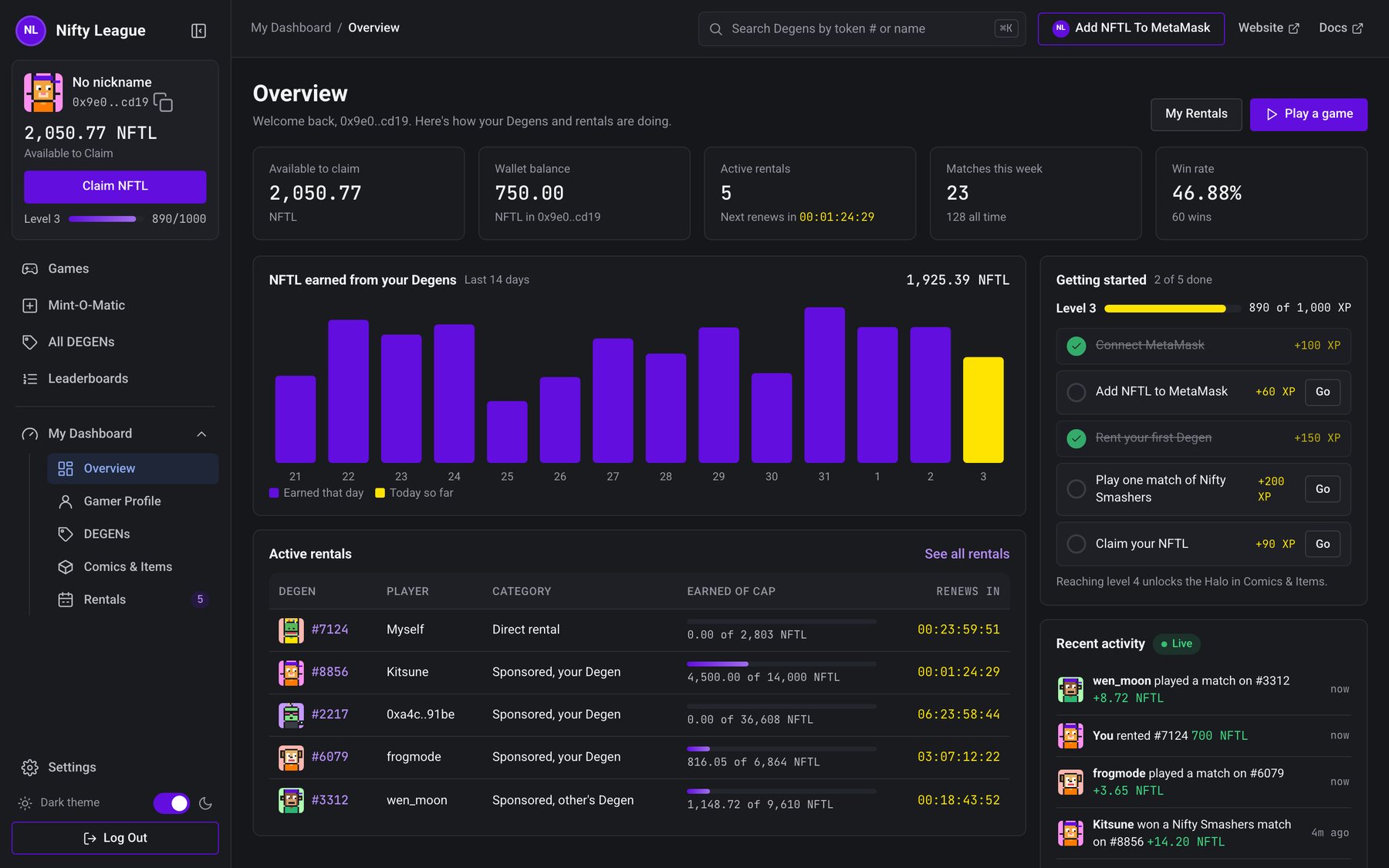
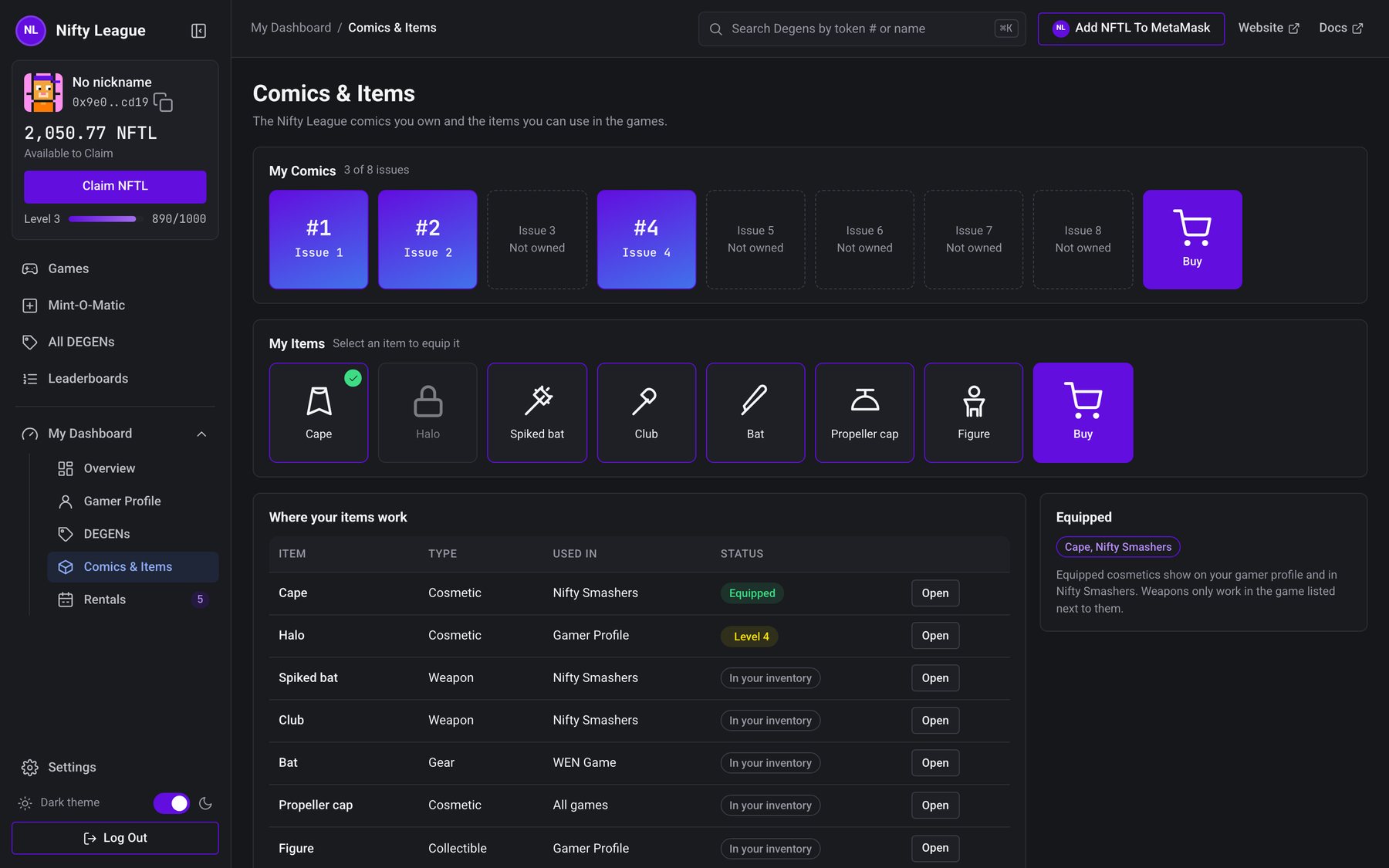
In 2026, I rebuilt the prototype in the original Nifty League style, with the purple, ink, and yellow palette from my style guide, Roboto, and pixel-art Degens that I drew in code. It now covers the screens from my original designs: the Games page, All DEGENs, My Rentals, Comics & Items, the whitelist settings, and claiming NFTL. I also added the onboarding quests, which I designed in 2026 for the second goal of the project.
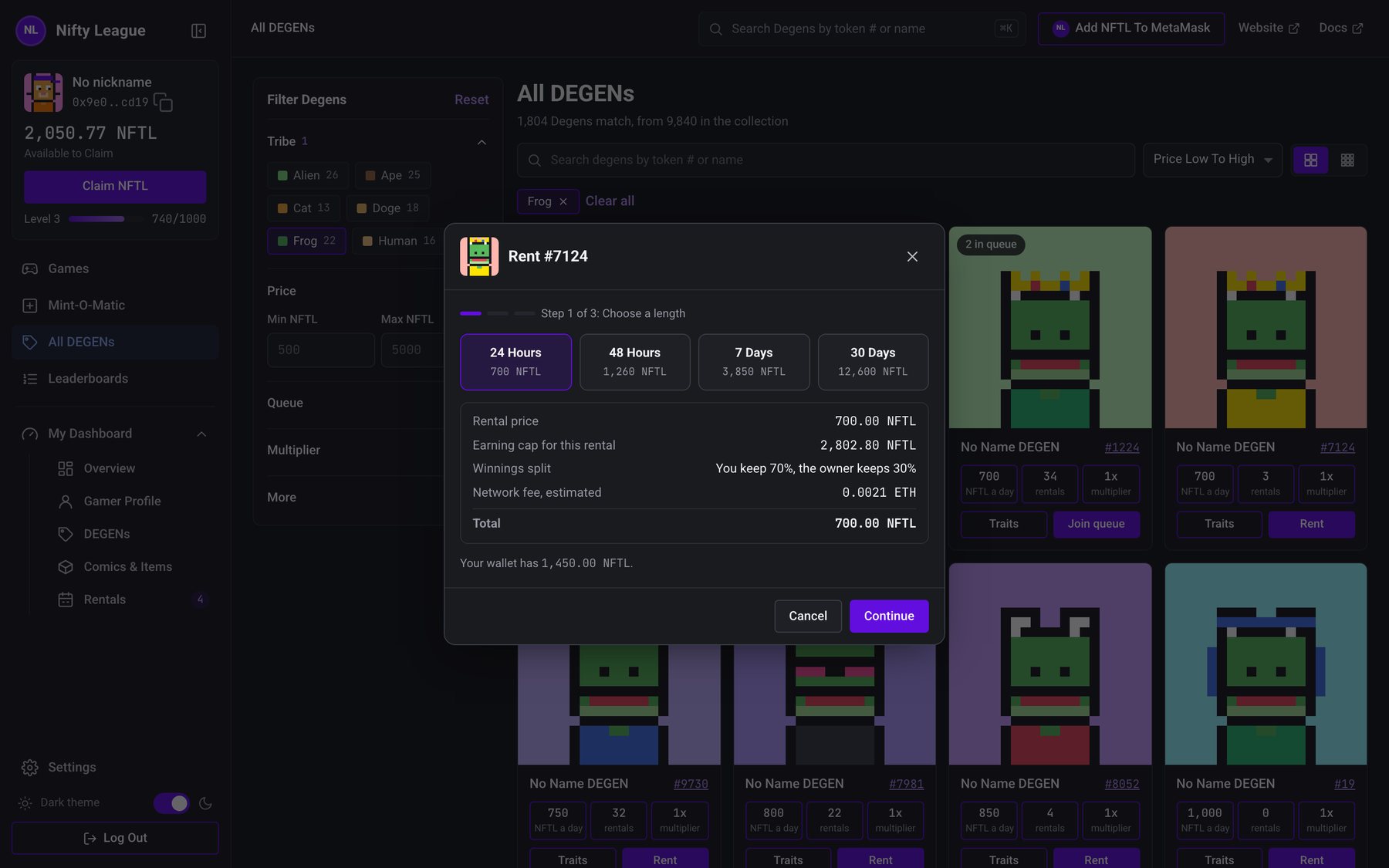
Try this: Open Games and press Play In Browser on Nifty Smashers, then connect MetaMask. The badge on the card will change to "You need a Degen", so follow the link, filter All DEGENs by the Frog tribe, and rent the first one for 24 hours. Play a match, then open My Dashboard, go to Rentals, and terminate the sponsorship of #8856. After that, claim your NFTL from the sidebar and open Overview to see your quests and your new level.
The product problem
A lot of Web3 games bury the game itself under token dashboards, jargon, and wallet actions that don’t connect to anything. Players needed to understand asset ownership, rentals, rewards, game access, and credits without feeling like they were using a finance product.
The public site and the product had to explain what the platform offered players, help them compare assets by rarity and yield, and then carry that decision into gameplay, the marketplace, or the dashboard.
Nifty League had sold out its NFT collection, but the platform still had serious problems with onboarding new players and keeping them. The way it was at the time, the flow from the marketing site to the game app was inconsistent and the information was thin. The dashboard also had a lot of buttons at the same visual weight, so new players couldn't tell which step came first or which page to open next.
I set two goals for the work. The first was to redesign the app with a clear visual hierarchy that guides players through the platform. The second was to design a progression system, so new players had a reason to come back after their first session.
Research
- I worked in four stages: project analysis, ideation and research, UX design and iteration, and prototyping.
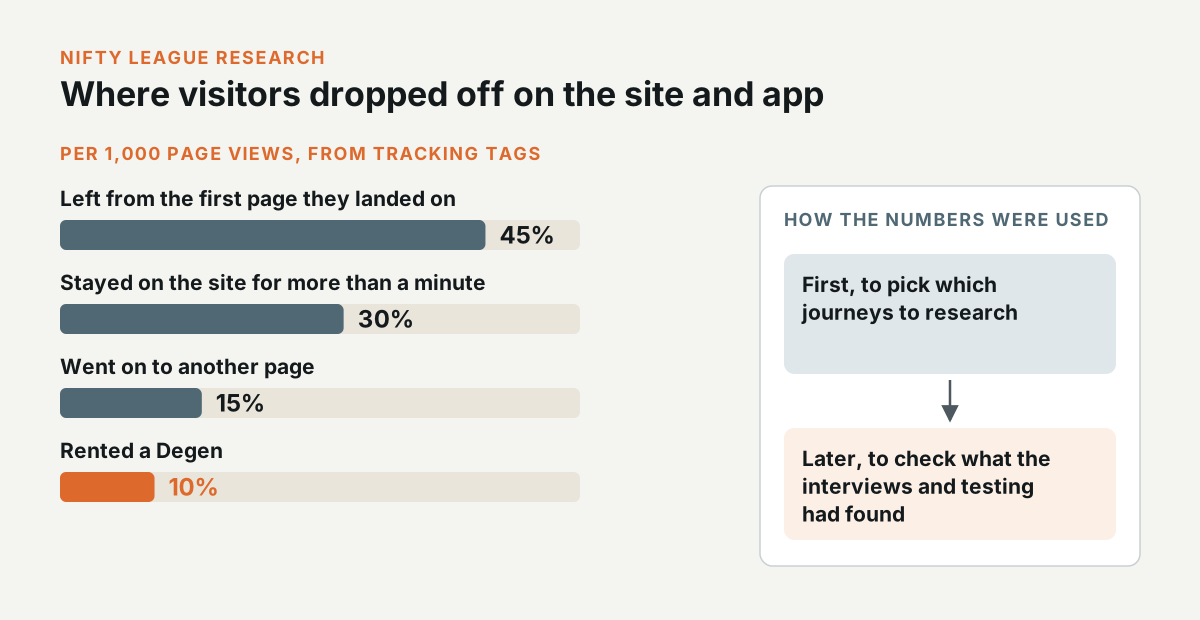
- Analytics: I added tracking tags across the site and the app to find out where players were getting stuck. Out of every 1,000 page views, 30% of people stayed on the site for more than a minute, and only 15% went on to another page. Only 10% rented a Degen, and 45% left from the first page they landed on. I used those numbers to pick the journeys to research, and later to check what I'd found in the interviews and testing.
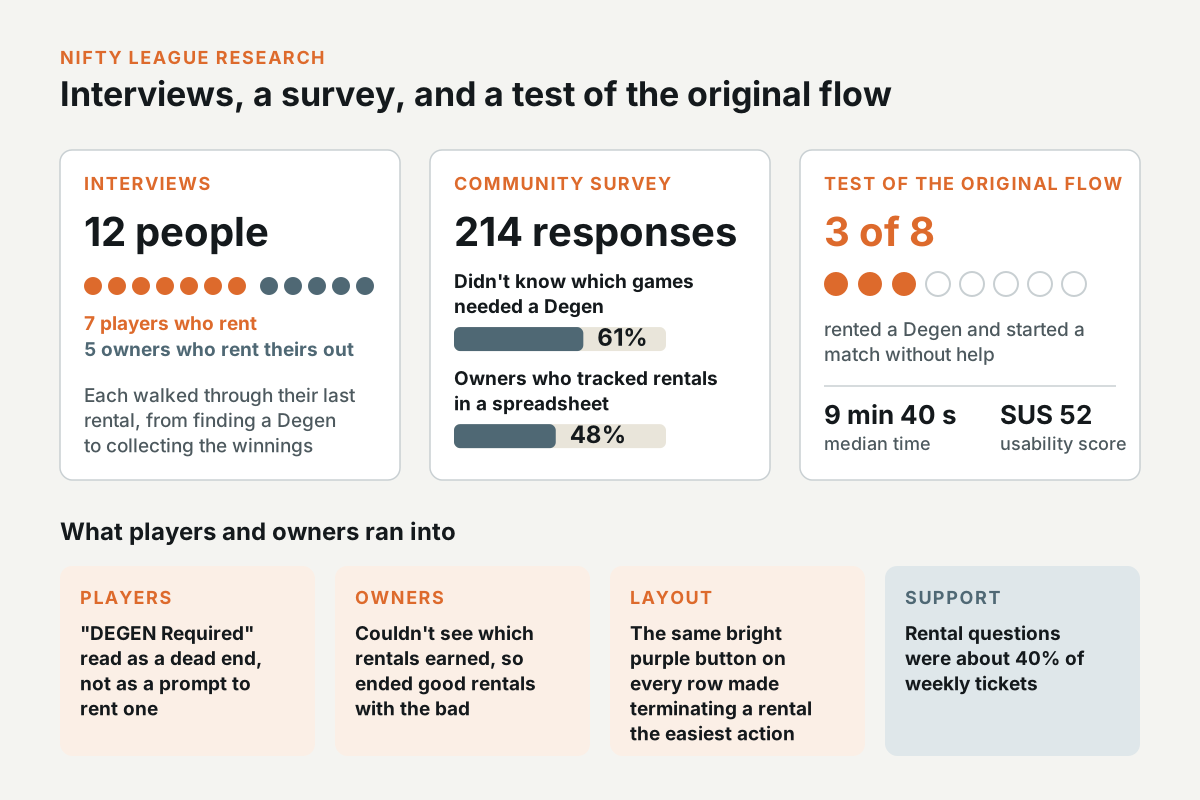
- Interviews: I spoke with 12 people from the community, 7 players who rented or wanted to rent a Degen and 5 owners who rented theirs out. I asked each of them to walk me through their last rental, from finding a Degen to collecting the winnings.
- Survey: I ran a short survey in the community channels and got 214 responses. 61% of the people who answered didn't know which games needed a Degen, and 48% of the owners tracked their rentals in a spreadsheet outside the platform.
- Usability testing: I tested the original rental flow with 8 participants. Only 3 of the 8 rented a Degen and started a match without help, and it took them a median of 9 minutes 40 seconds. The original flow scored 52 on the System Usability Scale.
- Key findings: Players read "DEGEN Required" as a dead end, and didn't realise they could rent a Degen to play. Owners couldn't work out which rentals were earning, so they terminated good rentals along with bad ones. Every row had the same bright purple button, which made terminating a rental the easiest thing to do on the page. The support team also mentioned that rental questions made up about 40% of their weekly tickets.
Users and jobs to be done
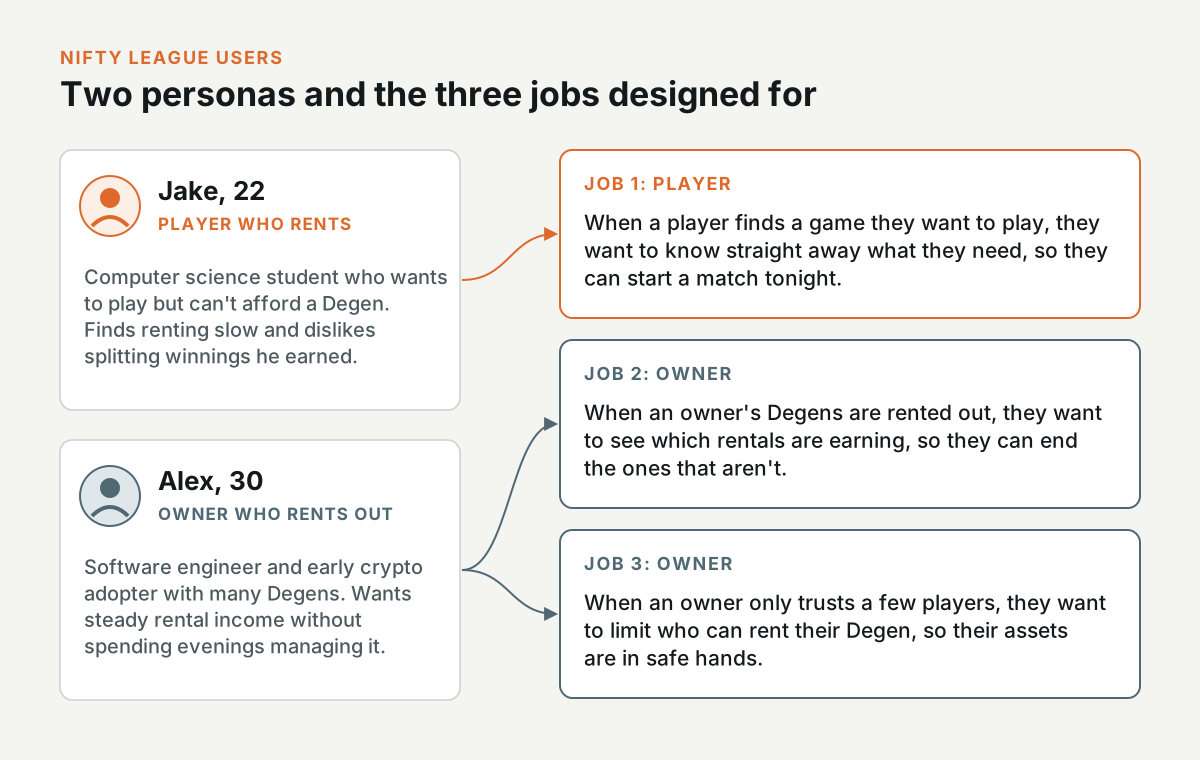
From that research, I wrote two personas. Jake is a 22-year-old computer science student who wants to play Nifty League but can't afford a Degen. He needs to find an owner who'll rent him one, so he can get into the game. He finds the rental process slow, and he doesn't like splitting his winnings when he did all the work to win.
Alex is a 30-year-old software engineer and an early crypto adopter who owns a lot of Degens. He wants steady income from renting them out without spending his evenings managing them. He also likes that he's giving players who can't buy their own Degens a way into the game.
I designed for three jobs. "When I find a game I want to play, I want to know straight away what I need, so I can start a match tonight." "When my Degens are rented out, I want to see which rentals are earning, so I can end the ones that aren't." "When I only trust a few players, I want to limit who can rent my Degen, so my assets are in safe hands."
What I designed
- Public and marketing pages: I presented Nifty League as a game first, and only then explained the ownership, reward, and marketplace mechanics behind it.
- Game dashboard: I designed the main view for balances, rewards, active leases, inventory, activity history, and the actions that connect assets to gameplay.
- Credit-system logic: I worked out how credits, rewards, and player progression fit into the game loop, so players saw credits as part of the game instead of an abstract token mechanic.
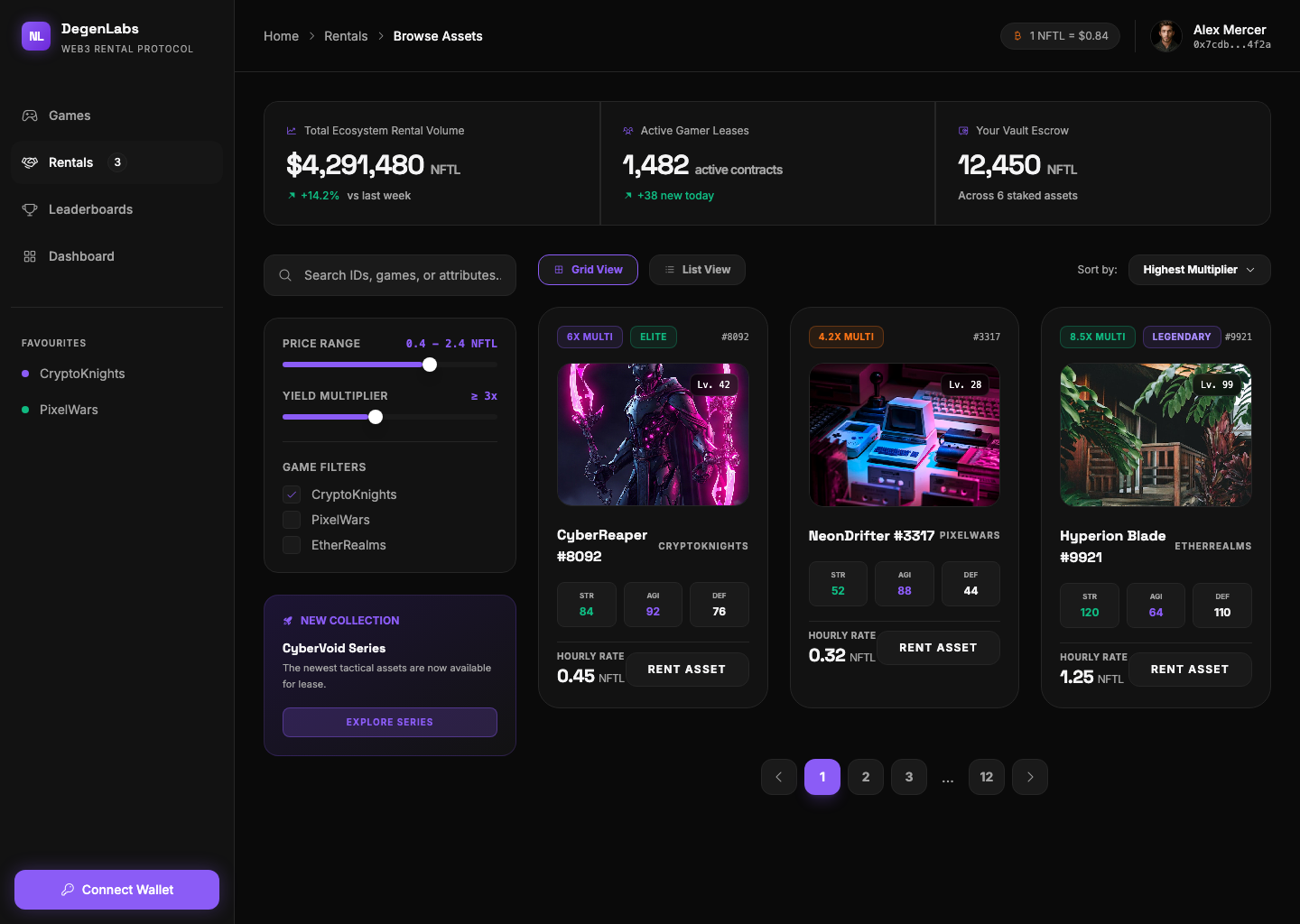
- Asset and marketplace flows: I designed how players compare assets, inspect metadata, and read multiplier and yield signals, and then decide if they want to rent or own an asset.
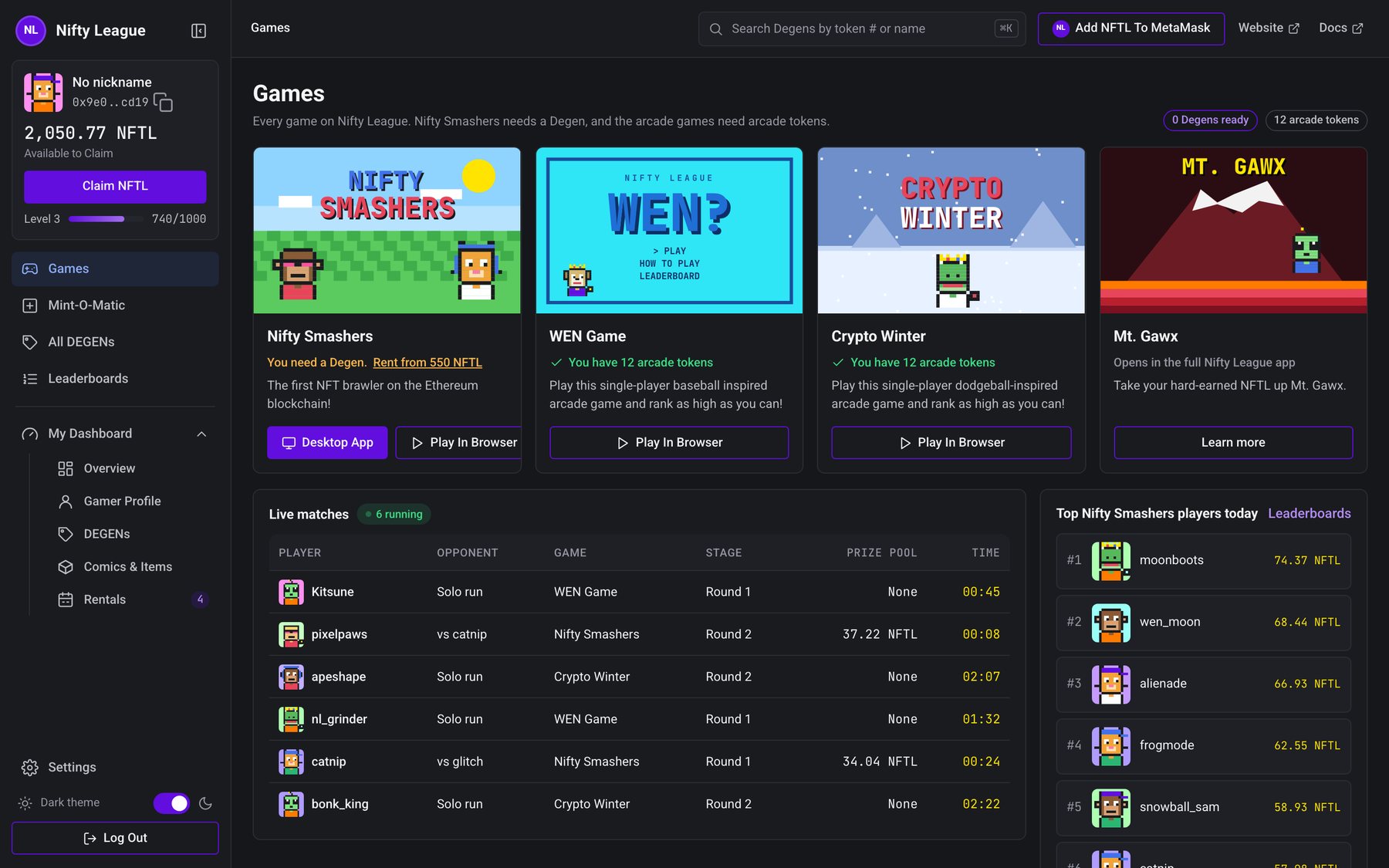
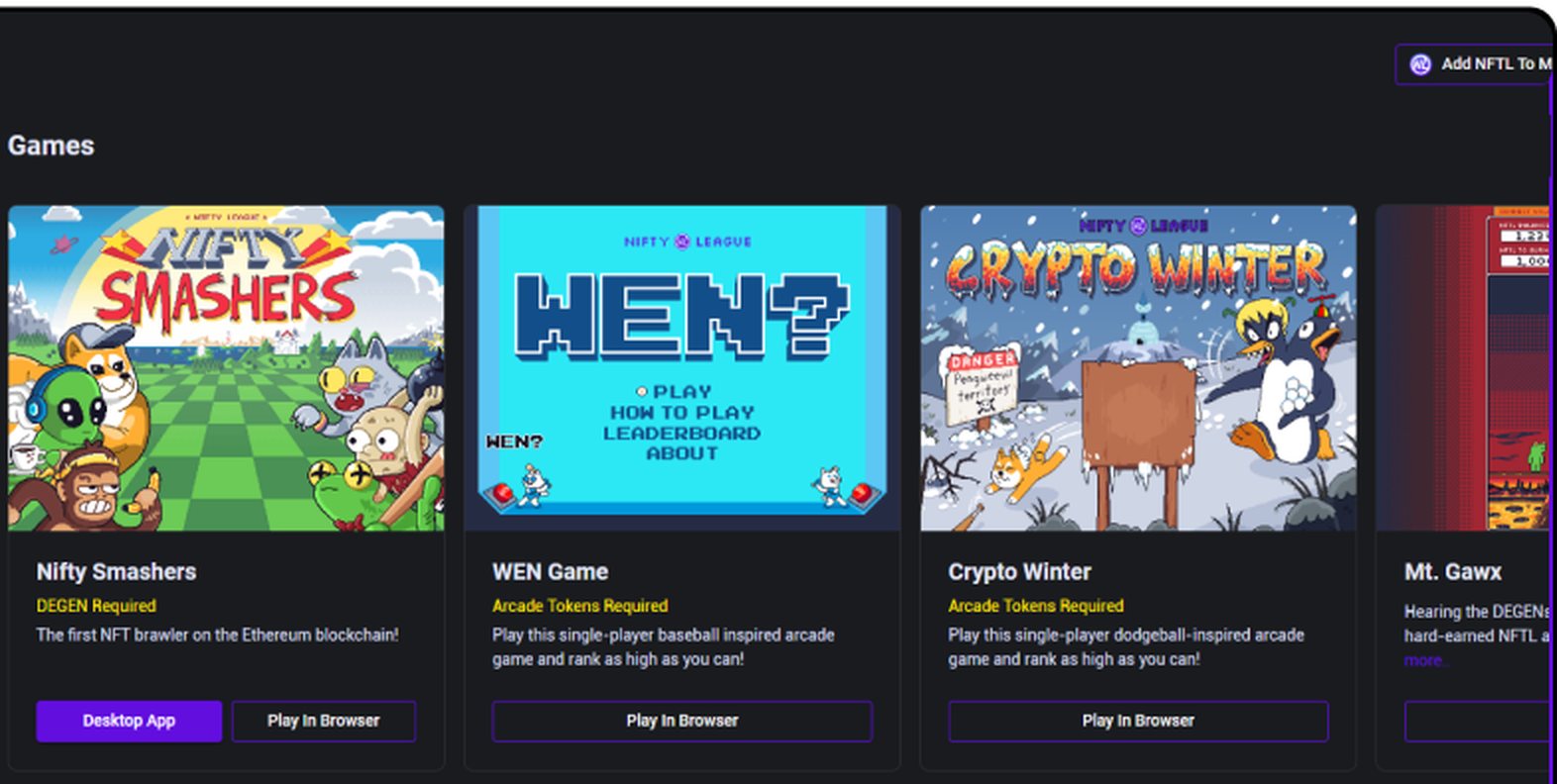
- Games page: Each game has a card with its cover art, the requirement to play it, and a short description. Nifty Smashers needs a Degen and can be played in the desktop app or in the browser. The arcade games need arcade tokens and run in the browser. MetaMask authentication is required before any game opens.
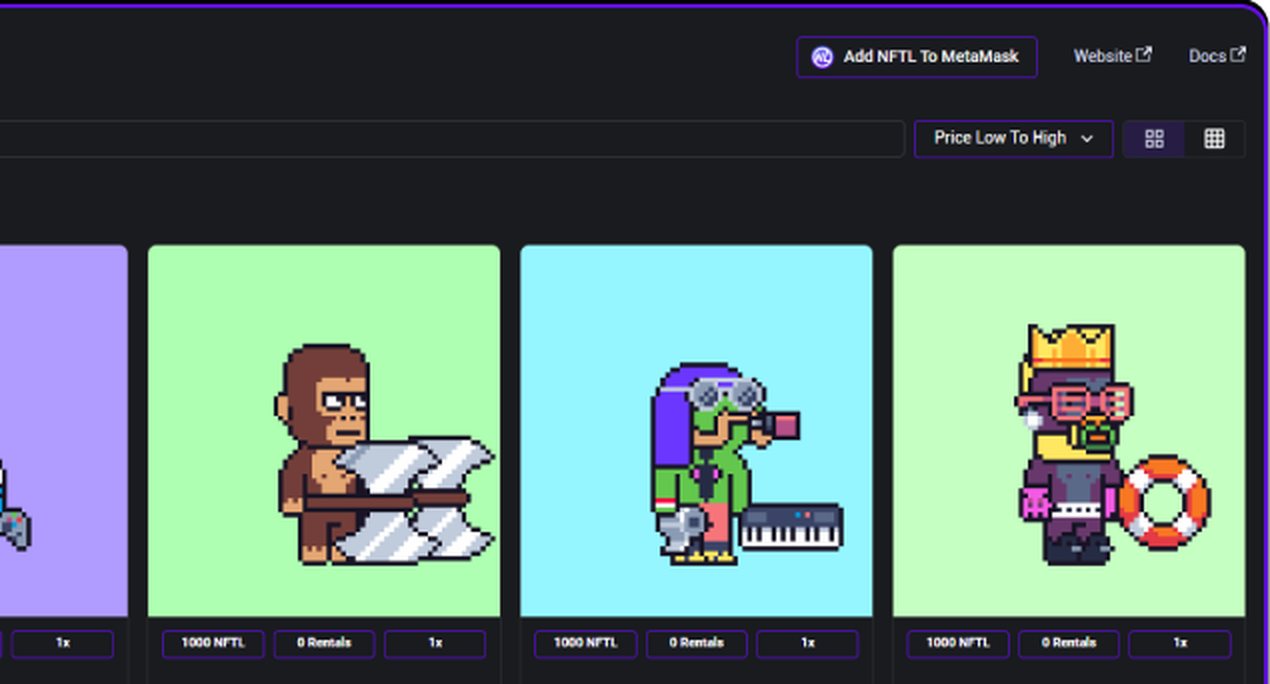
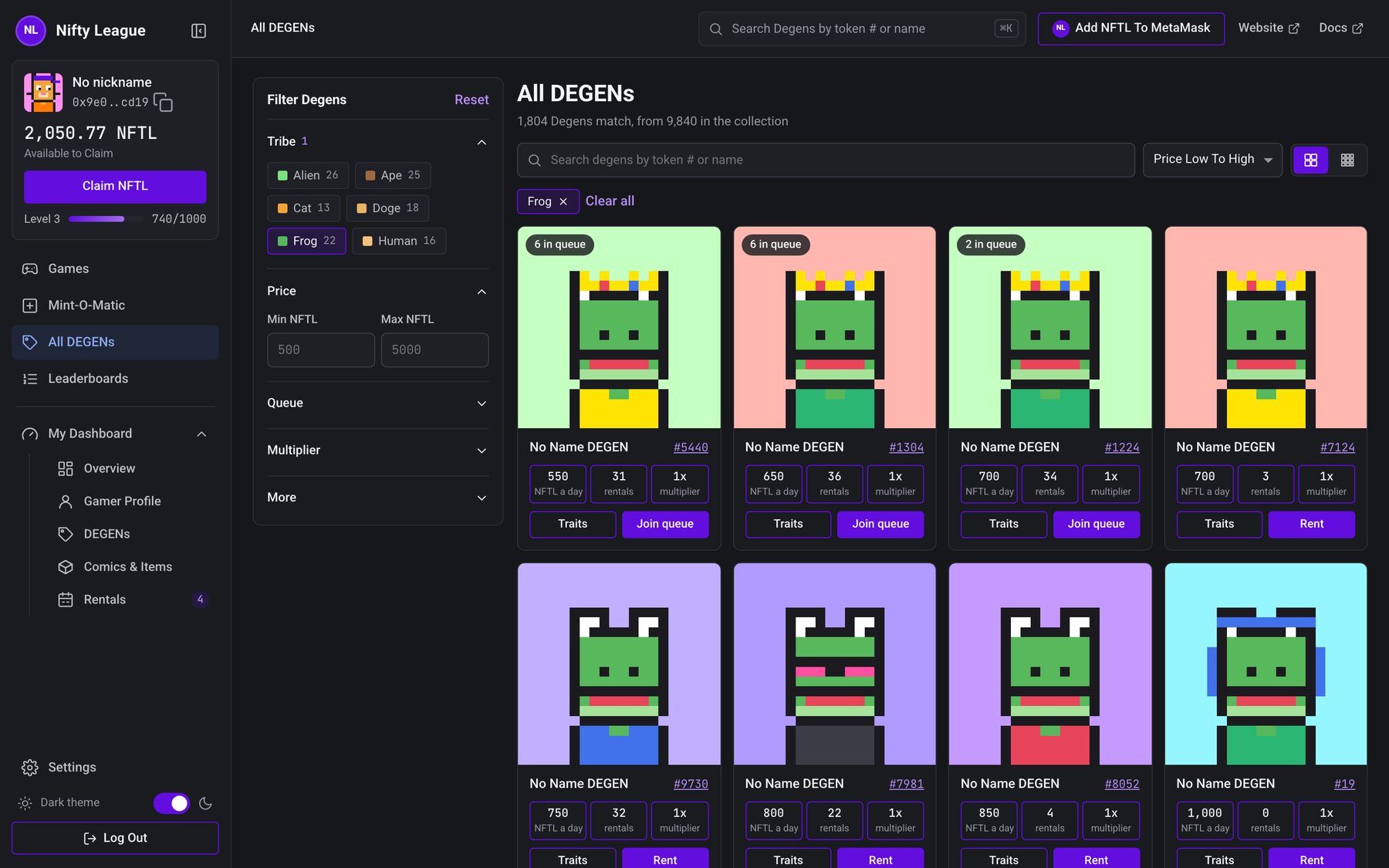
- All DEGENs: This page lists all 9,840 Degens ever minted. Players can search by token number or name, filter by tribe, price, multiplier, and rental queue, and sort by price. Each card shows the rental price in NFTL, the number of rentals, and the multiplier, so a renter can compare Degens without opening each one.
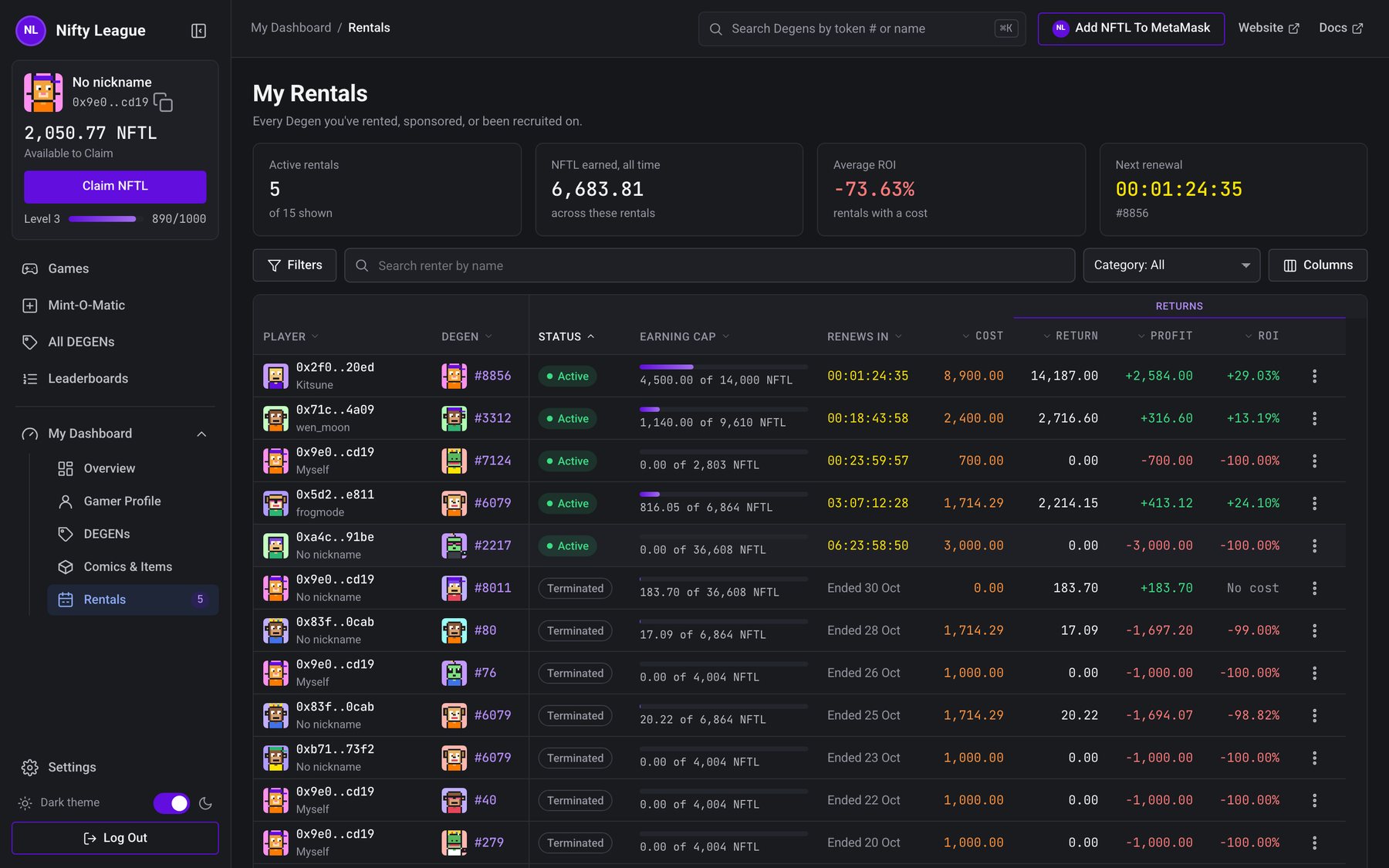
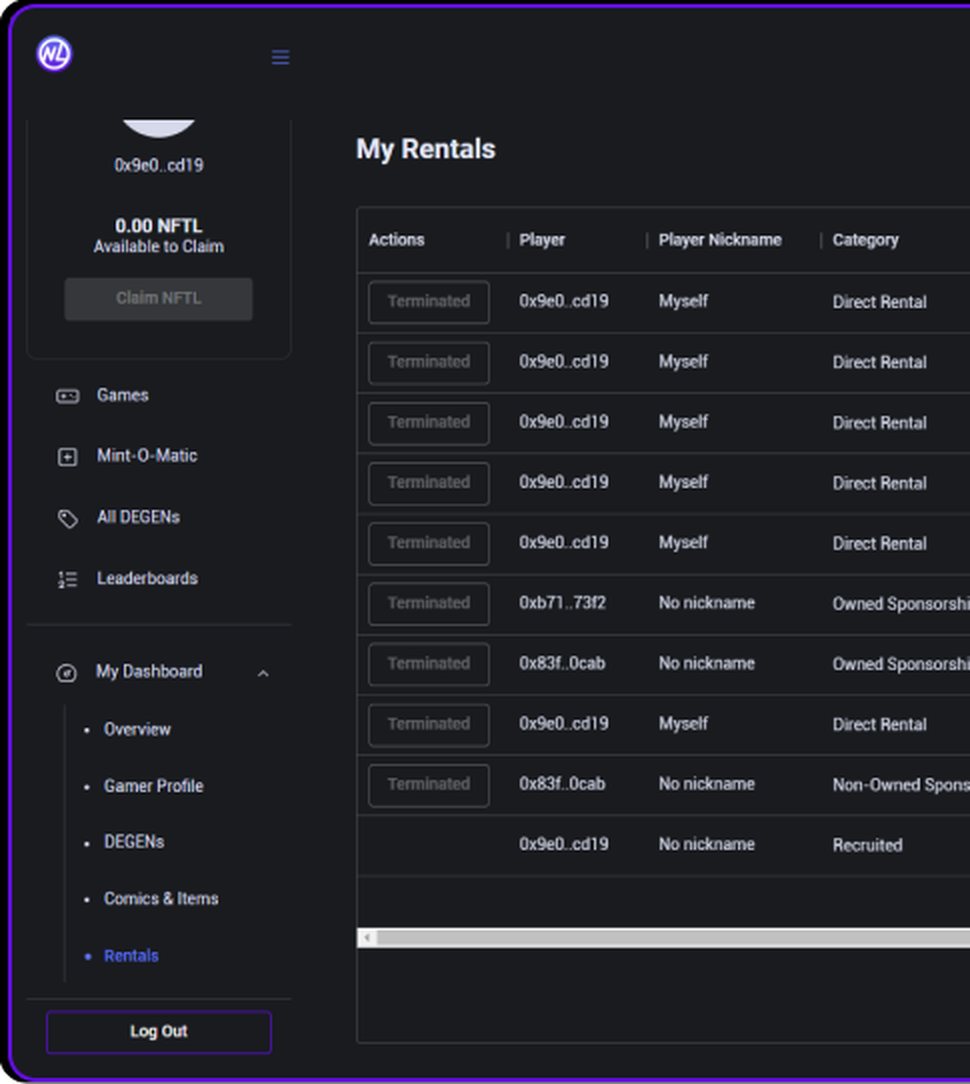
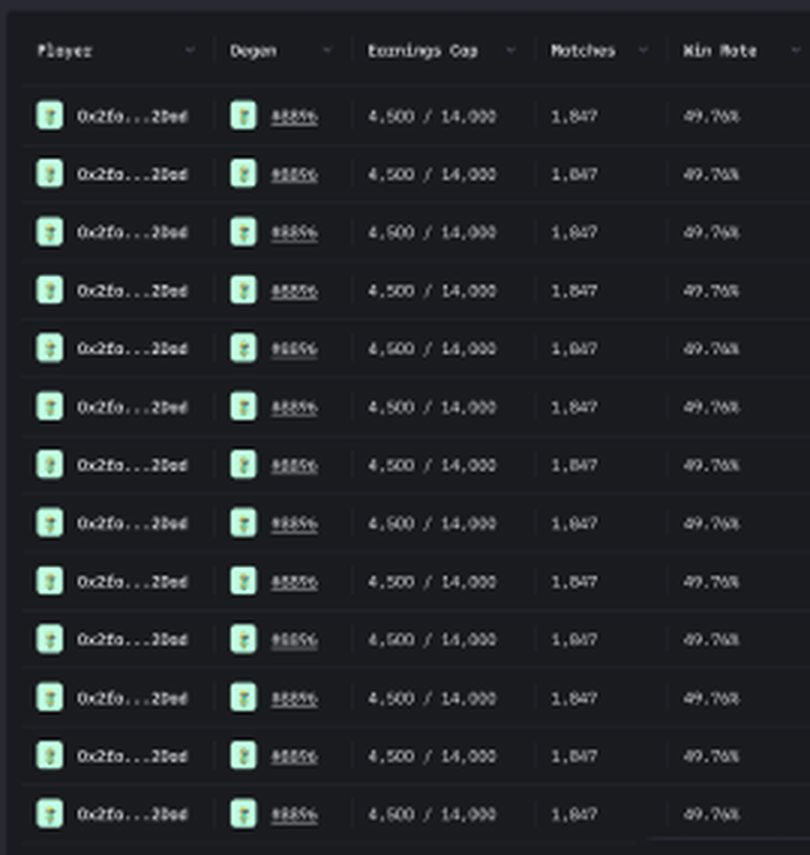
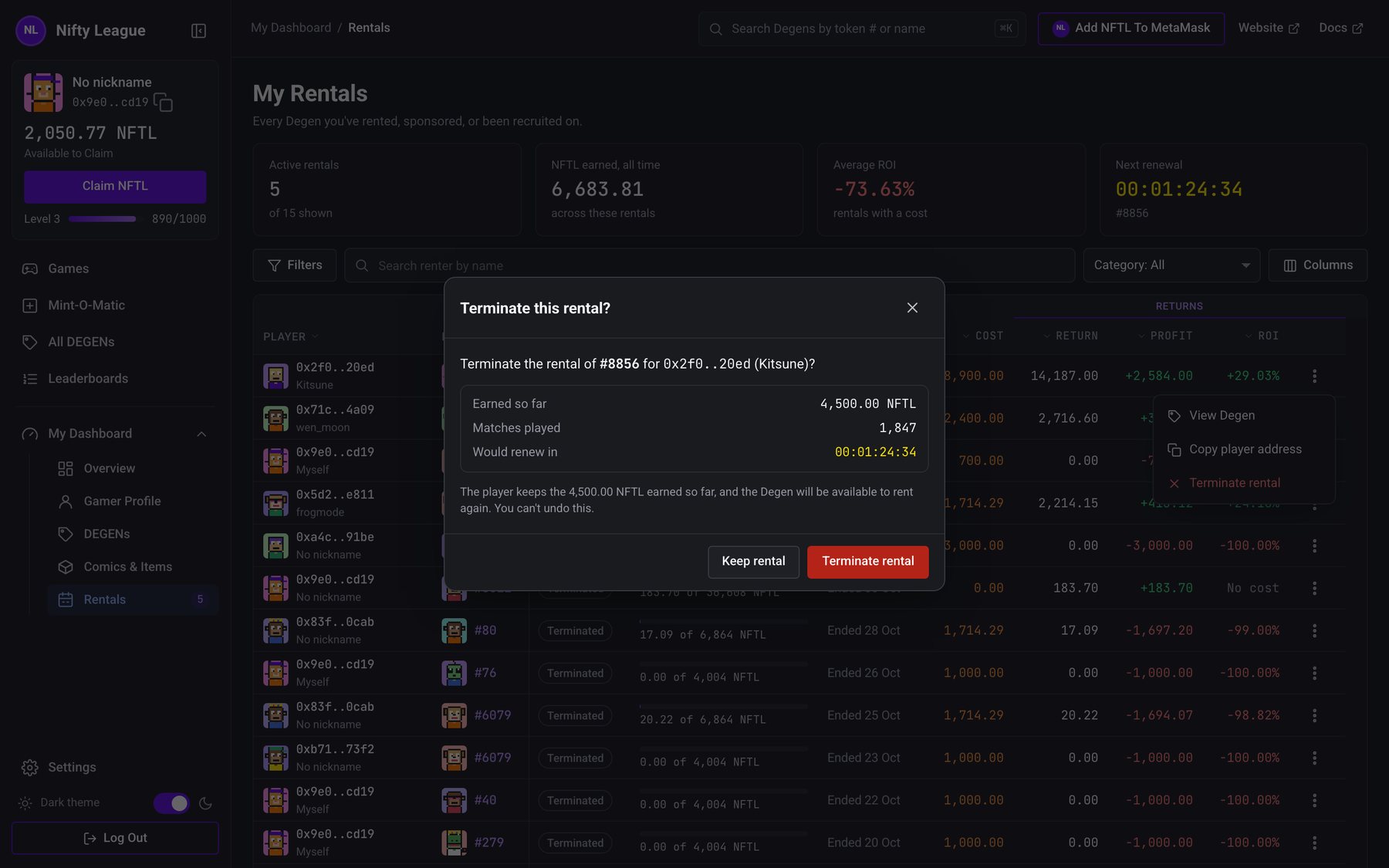
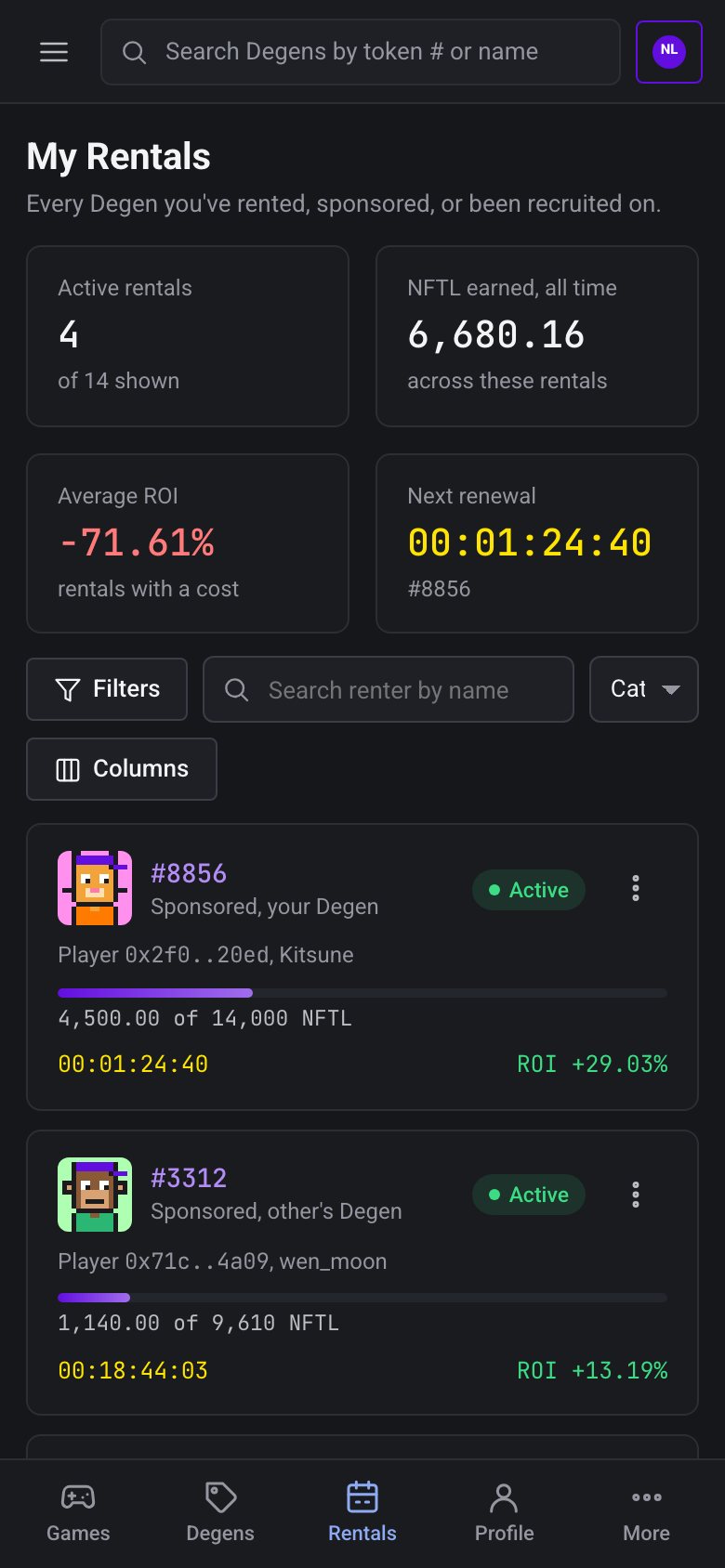
- My Rentals: Owners and renters have every rental in one table, with the player, the rental category, the Degen, its tribe and background, the earning cap, the renewal timer, the multiplier, and the matches played. The categories are direct rental, owned sponsorship, non-owned sponsorship, and recruited. In a later concept, I designed a filter panel for earning timeframe, role, return on investment, rental state, background, and tribe, with an all-time CSV export for owners who do their own accounting.
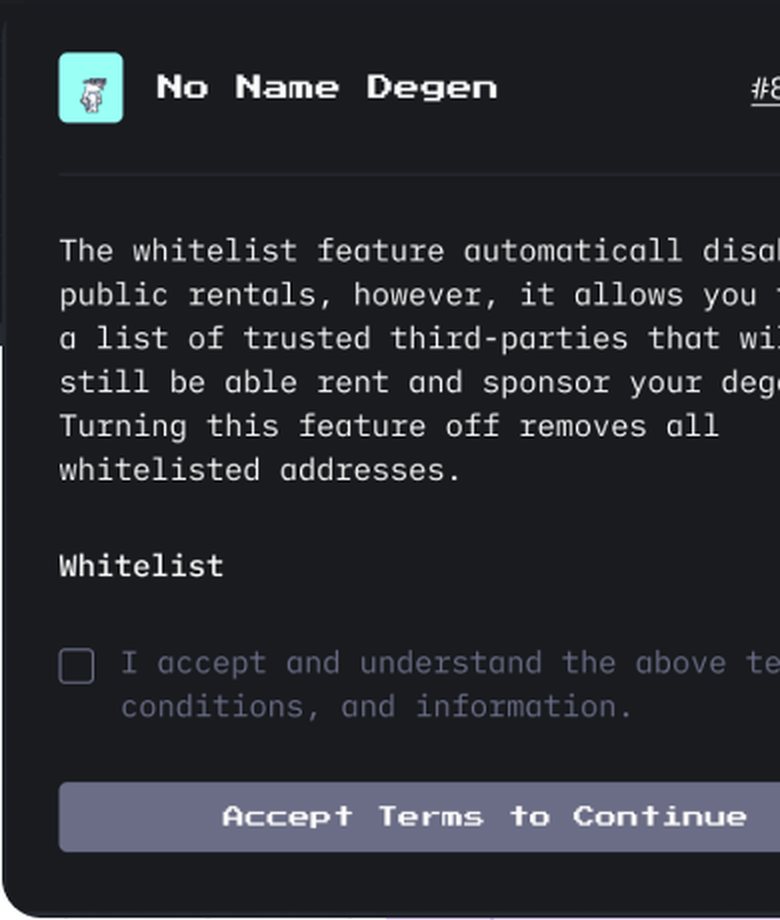
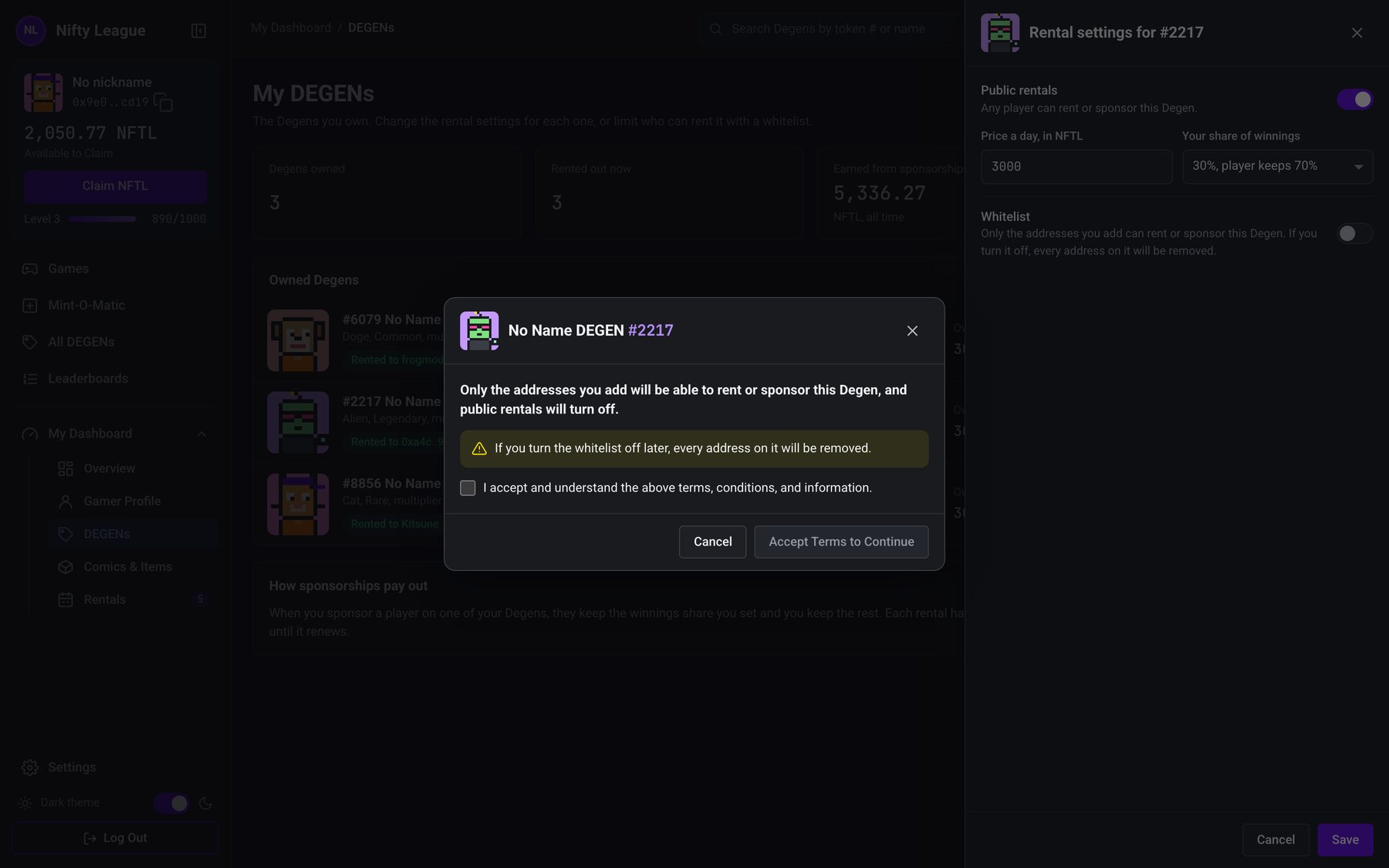
- Whitelist: Owners can turn on a whitelist for a Degen. When it's on, public rentals are turned off and only the addresses the owner trusts can rent or sponsor it. Turning it off removes every whitelisted address, which is why the owner has to accept the terms before the change goes through.
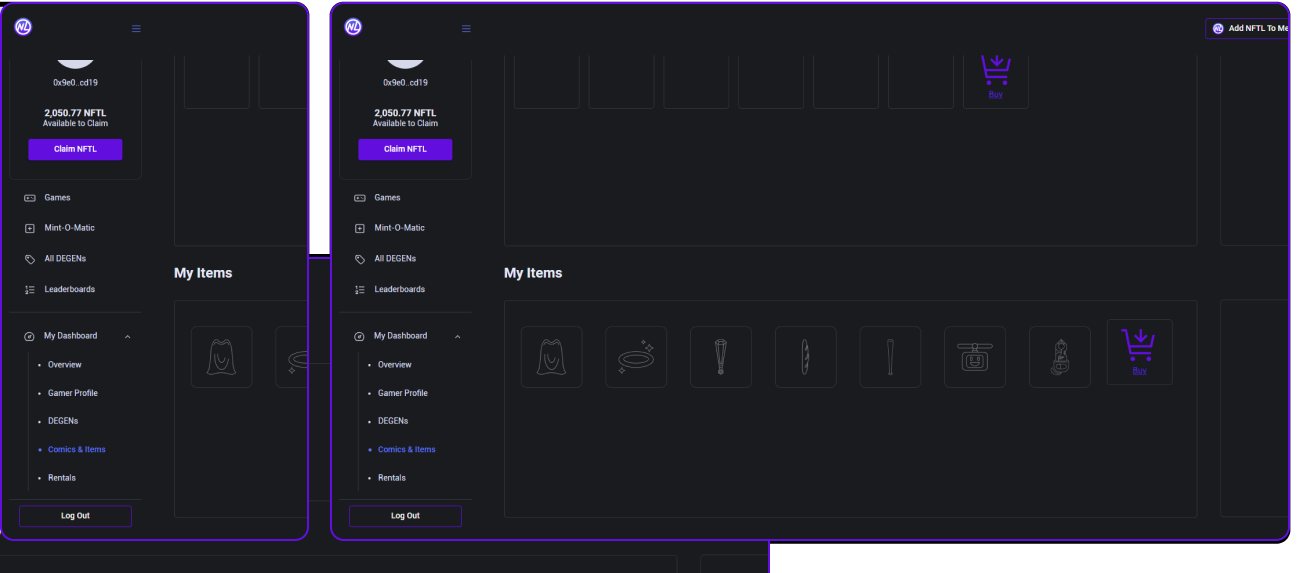
- Comics & Items and claiming NFTL: The dashboard holds the player's comics and in-game items, with a buy link for the ones they don't have yet. In the sidebar, players can always find the NFTL they can claim, a claim button, and a shortcut to add NFTL to MetaMask.
- Style guide: I built the interface on four colours: purple #620EDF for actions, yellow #FEE400 for highlights and timers, blue #4172EB for navigation, and ink #191B1F for the dark background. Everything is set in Roboto, with regular for body text and labels, medium for buttons and minor titles, and bold for headings.
Flow and interaction model
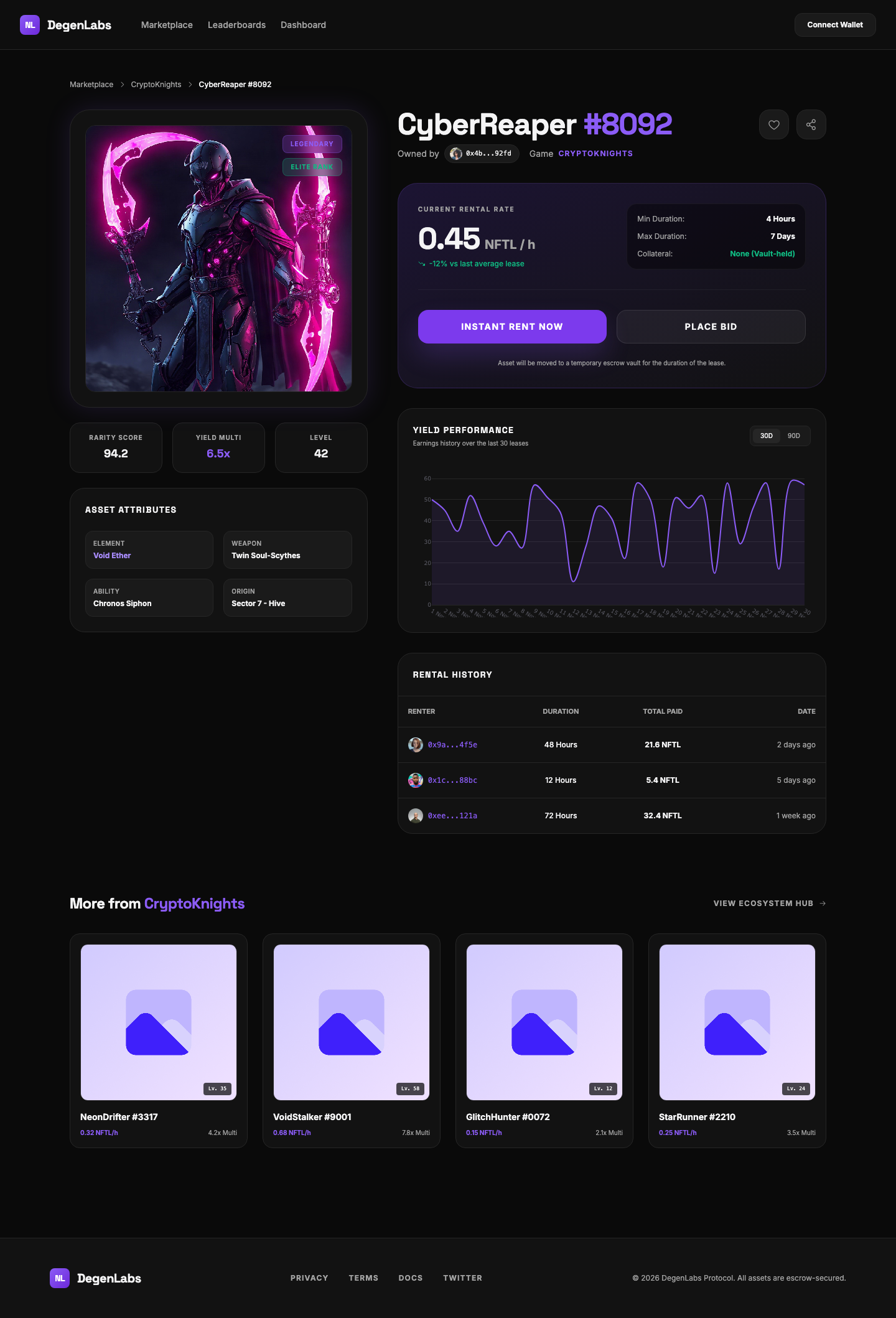
- Marketplace to decision: Players browse assets, filter by game or category, and open a detail view with traits, rarity, yield history, and rental history.
- Decision to action: On the asset page, renting straight away and placing a bid are separate actions. After that, the dashboard handles staking, lease management, reward claims, and inventory review.
- Action to recovery: The wallet onboarding, transaction failure, and missing-page screens show how players get back on track when the main flow breaks.
My original user flow starts on the home page and splits two ways. One path goes to the Degens catalogue, where players filter by tribe, price, and multiplier. The other goes to the dashboard, where players sign up or log in with MetaMask. Once they're connected, they move from the games page to a game, their assets, the leaderboards, and their gamer profile.
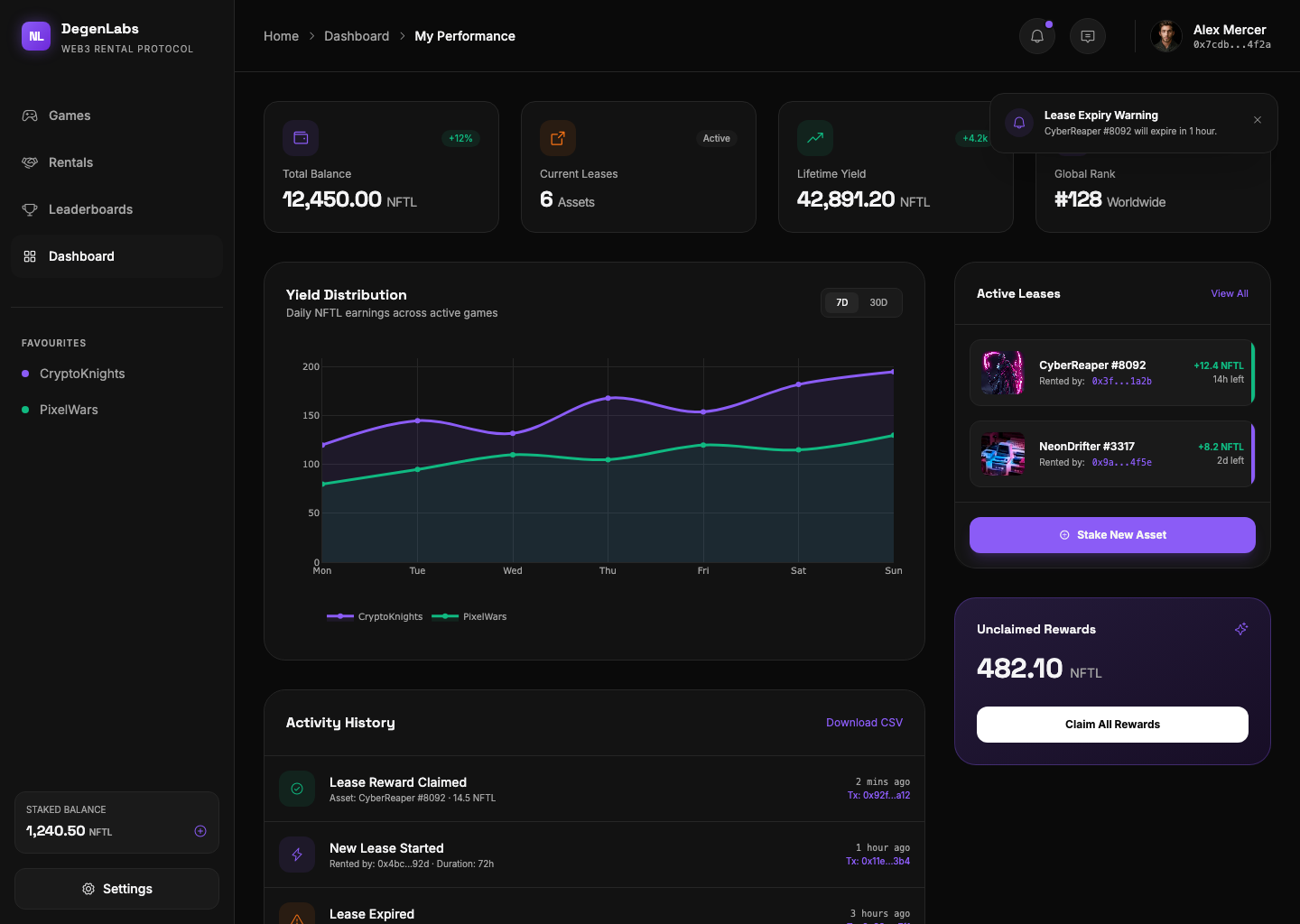
Extended surfaces
- Game hub: Each game has its own page showing economy health, rentable assets, participation, staking prompts, recent leases, and top earners.
- Leaderboard: Global rankings show how players are performing and which rewards are available.
- Settings and wallet onboarding: Account setup, public profiles, notifications, privacy, and connected-wallet controls round out the main product flows.
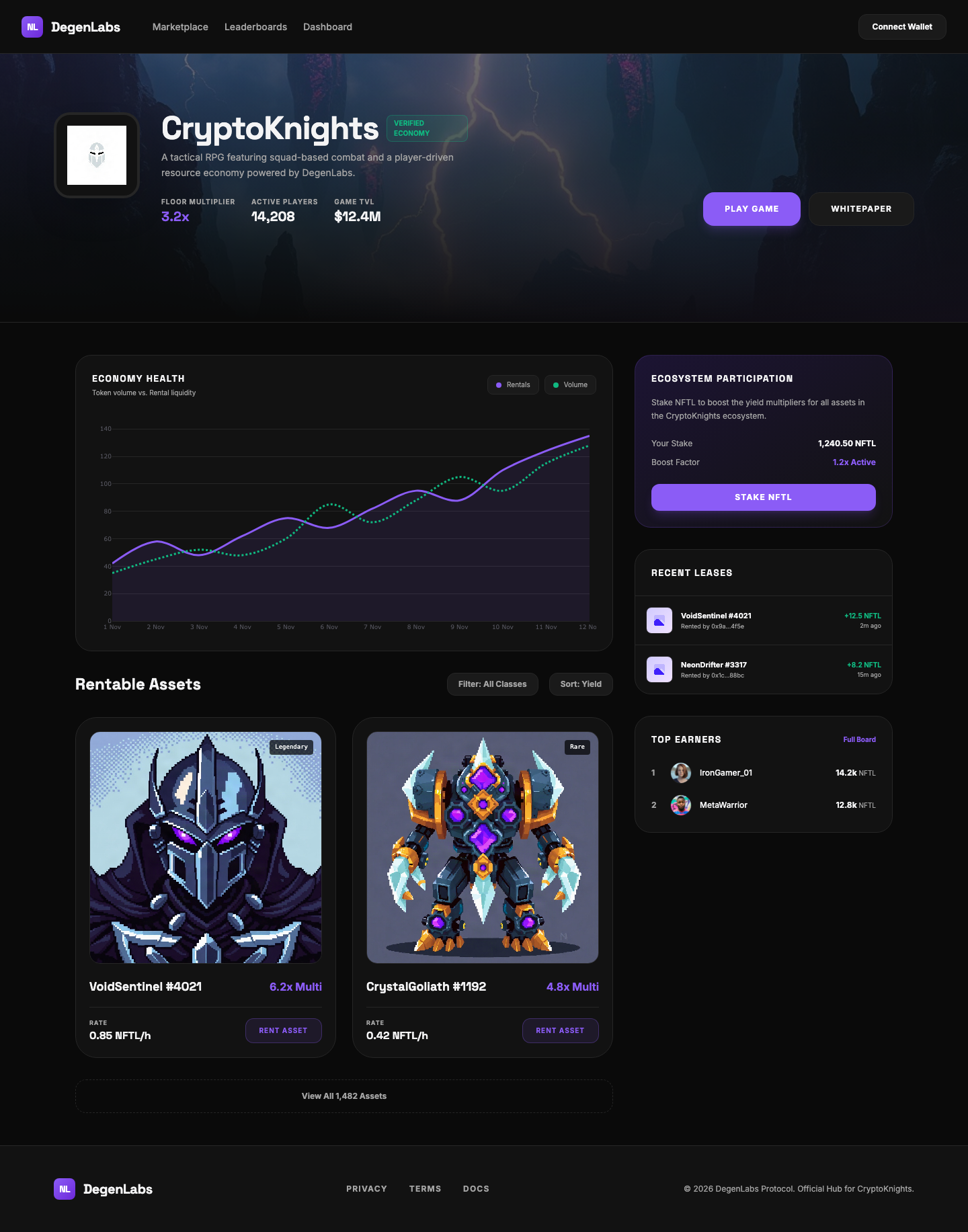
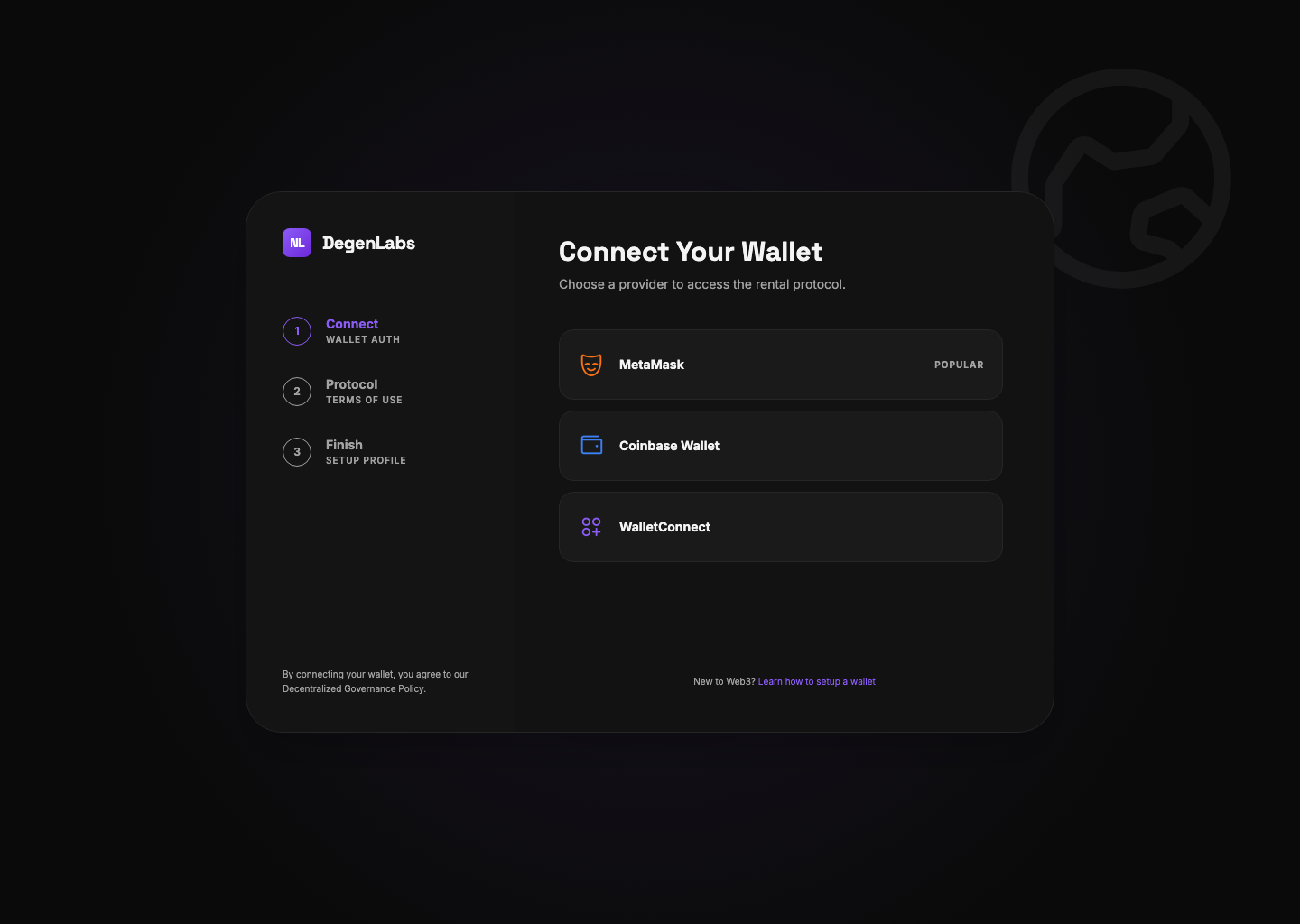
How I redesigned it
In 2026, I rebuilt Nifty League as a coded prototype. I kept the brand from my style guide: the ink background, purple for actions, yellow for timers, blue for navigation, Roboto for text, and the pixel-art Degens, which I drew in code instead of using the real artwork. I added JetBrains Mono for wallet addresses, token numbers, timers, and money, because its tabular figures keep the numbers in each column aligned.
- Rentals table: In the original, the rentals table had 11 columns at the same weight, and the rows were about 19 pixels tall, so owners couldn't scan it. In the redesign, the player and the Degen are pinned on the left. Cost, return, profit, and ROI are grouped under one Returns header, and the numbers are right-aligned in a monospace face. This way an owner can read across a row and work out straight away if a rental is earning. The columns an owner doesn't need every day are in a column chooser, and the filter panel opens as a drawer, so the default table fits the screen.
- Terminate action: Every row in the original had a bright purple Terminate button, which made the destructive action the loudest thing on the page. I moved it into a row menu as "Terminate rental" in red, and added a confirmation with the earnings so far and the time left before the rental renews. Purple now only marks the main action on each page.
- Rental status: Terminated rentals used to have a disabled button and a timer stuck at 00:00:00:00. I replaced both with a status pill and the date the rental ended, and active rentals have a live countdown. Owners can filter by state and see the active rentals first.
- Game requirements: The original card said "DEGEN Required" and stopped there, and in testing, players read it as a dead end. In the redesign, the badge changes with the player's wallet. If they have a Degen ready, the badge has its token number. If they don't, the badge links to the cheapest Degen they can rent, and the rent sheet points them to the arcade games, which they can play without a Degen.
- Earning cap: The original showed the cap as "0 / 4,004.00", which is hard to scan. I turned it into a progress bar with the amount under it, like "6.75 of 4,004 NFTL".
- Whitelist modal: The original modal was a block of monospace text, with the consequence in the middle. I rewrote it to lead with the outcome, put the warning about removing addresses in its own note, and kept the terms checkbox, because the owner should confirm the change on purpose.
- Onboarding quests: The second goal of the project was a progression system, and I designed it in 2026 as a quest list on the Overview page. New players connect MetaMask, add NFTL to MetaMask, rent a Degen, play a match, and claim their NFTL, and each step earns experience towards the next level. The quests follow the shortest path from landing on the site to a first win.
- States and accessibility: I raised the contrast of the muted text, the requirement labels, and the profit and cost colours to at least 4.5:1 on both themes, and added a light theme. I also designed empty, loading, and error states for every list and every wallet action, including a rejected signature, the wrong network, not having enough NFTL, and another player renting the Degen first. Under 760 pixels wide, the sidebar becomes a bottom tab bar and the rentals table becomes a list of cards.
- Retest: In a retest of the redesigned flow, 7 of 8 participants rented a Degen and started a match without help. The median time went down to 3 minutes 10 seconds, and the SUS score went up to 78.
Impact
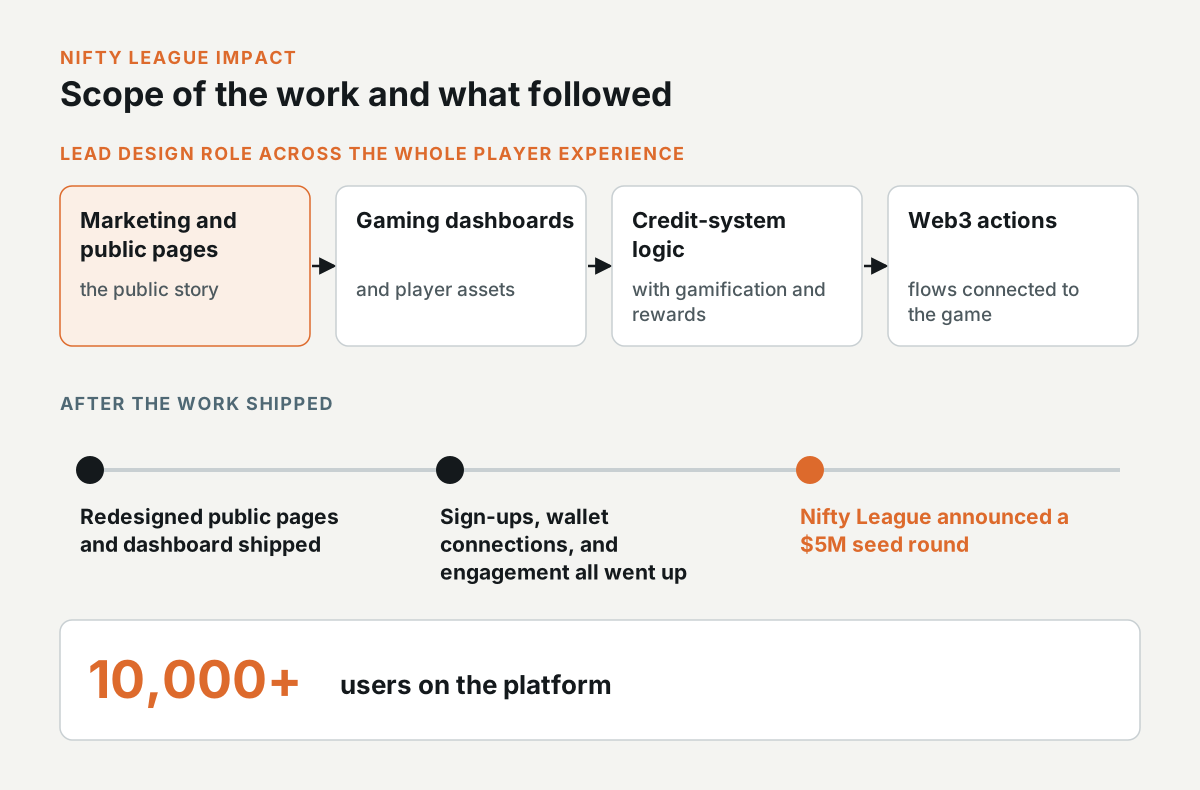
I worked with the Nifty League team as lead designer on the gaming dashboards, gamification systems, player assets, credit-system logic, and the marketing and public pages for a Web3 gaming platform that later announced a $5M seed round.
My work covered the whole player experience, from the public story to the dashboard, the credit and reward logic, and the flows that connected Web3 actions to the game.
More than 10,000 users used the platform. After the redesigned public pages and dashboard shipped, sign-ups, wallet connections, and engagement all went up, and Nifty League announced its $5M seed round after my work had shipped.
Need this level of detail in your product?
Work through the hard product decisions early.
If you’re a product team, that can mean a focused design, system, or prototype project. If you’re hiring, it’s a chance to look closer at how I work across research, interfaces, and code.